



"That looks about right."
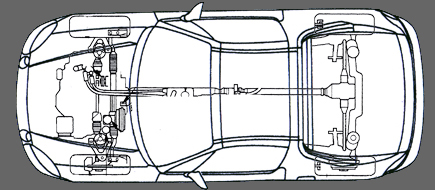
Project Sol-37 - All Wheel Drive CRX del Sol
Engine
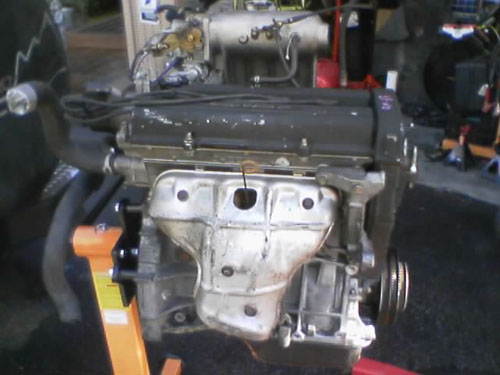 Honda's 2.0 litre dual over head cam non-vtec B20B is said to generate 126 horsepower at 5400 rpm and 133 foot pounds of torque at 4300 rpm. The nice thing about this engine is that it has a torque line and not so much of a curve when you look at a dyno graph, and is very consistent through out the rpm range. Since the Honda CRV is designated a light truck according to the California Air Resources Board (C.A.R.B.) and it is against California's Emission laws to install a light truck engine into a passenger vehicle, the state does not deem the Sol road legal. To satisfy California's regluations a B18B engine out of a 1994 Acura Integra LS is being built to B20B specifications with the intention of having the car Refereed to make it once again legal for use on California's public roads.
Currently the engine is being managed by the car's original P06 ECU that was programmed for the economic D15B7. It works well, but it could be better. A lot better. The plan is to take the P06 and chip it so that it can be re-programmed with better fuel and timing maps as well as institute a two step launch control rev-limiter.
The first modification to the engine will be the addition of a VTEC equipped cylinder head from a B16A engine. This should increase engine output by another 60 bhp with the proper fuel and timing maps. Later a modified Garrett VNT 25 turbocharger and larger fuel injectors will be fitted. The B18B engine is being built to withstand the added strain of the turbocharger.
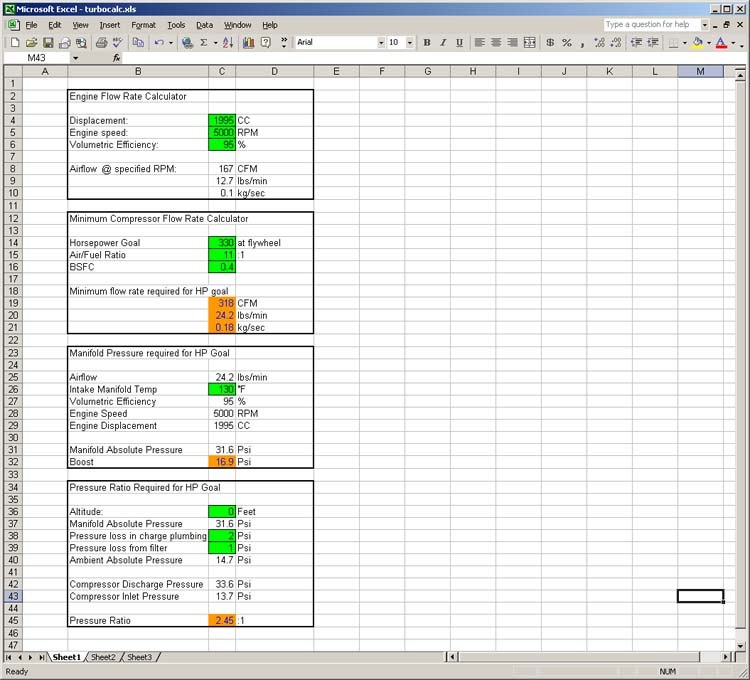 It is important to match flow rates when adding a turbocharger to an engine that is usually normally aspirated to ensure the longest possible lifespan of both. Before anything else happens, the horsepower goal must be set and the flow rates of the engine must be calculated. Using a spreadsheet containing all relevant formulae to calculate flow rates based on engine size, rpm, volumetric efficiency, BSFC, A/F, and horsepower estimates is highly recommended. Once a flow rate table has been filled out for different rpm levels at different pressure ratios, a turbocharger can be chosen and size does matter in this case. Smaller turbochargers are good for quick spool and low end grunt while the larger turbochargers boost top end performance and take a while to get going, however it is possible to have the best of both worlds.
Variable geometry turbochargers, variable vane turbochargers, or variable nozzle turbochargers use a vane mechanism in place of a waste gate. These vanes adjust their angle to the best possible A/R ratio at any given time. This means your larger turbocharger spools at a much lower rpm, virtually eliminating any lag. A very good article describing how VNTs work can be found behind this link.
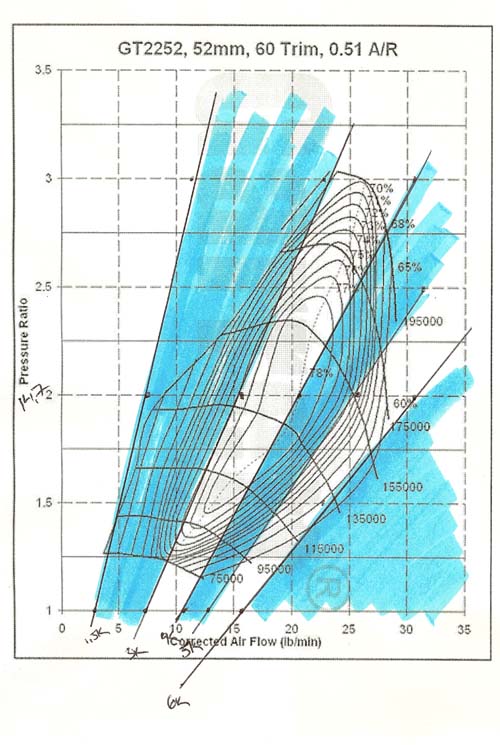
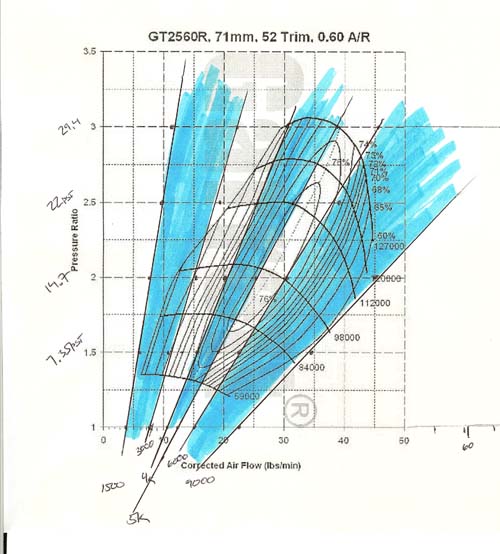 A Garrett 465599-6 VNT that had been removed from a 1990 Dodge Daytona VNT was purchased via an ebay auction and disassembled upon delivery. It was determined to be a 51.5mm 60 trim with a .48 compressor A/R and a .64 exhaust A/R. Using a compressor map from a 52mm 60 trim, it was determined that the stock compressor would be too small to meet the goal of roughly 300 wheel horsepower around 5000 rpm. If the stock compressor was used, it would fall below 60% efficiency over 6000 rpm. Other compressors were mapped and the best fit would be a 71mm 52 trim wheel. Unfortunately a 71mm wheel what would fit the VNT 25 could not be found and a 68mm wheel was chosen.

Copyright 2009